Donnerstag, 28. März 2013

Ultimate Shotgun Wedding Checklist

Sometime within the famous 12 days we had to plan our wedding, once the chaos had subsided to the effect that I could spend a few minutes poking around the internets ("How does this wedding stuff work?"), I came across these wedding checklists. I read the first couple lines of the first one I saw, showed it to Steve and we both burst into laughter. Then we decided that later, after it is all done, we'd have some fun with it, take one of these and adapt it to how our wedding worked, for a "shotgun wedding checklist". (No, I am not pregnant. Enough people asked me, believe me. But 12 days is 12 days, so we think we had some shotgun-wedding-ish elements to it.)

Disclaimer:
I do not mean to sneer at people who wanted and had the big elaborate wedding. The fun I am having with this is mainly about the discrepancy between how obsessively one could go about planning one's wedding and how it happened for us. And a little bit about those checklists themselves.

So, this (somewhat shortened) beauty is from a website that ironically invokes simplicity in its name. And perhaps it's not even that ironic, since it's not a monster with multiple inter-linked sub-checklists. It is neither complete nor consistent, and by far not the most extravagant one out there (others suggest you "start your fitness and diet plan" 18 months before and "get a spray tan" a week before). It is directed exclusively at the bride and sorely lacking anything to do with the groom, but as odd as I thought that was at first, it actually seems to be pretty standard. Browsing through anything wedding related on the interwebs, there seems to be no particular expectation that men have a say in any of this, or that the groom is even an independently thinking agent (as evidenced by list items like "Get your groom to choose a Best Man"). But I digress. This shall not be a social rant.


Enjoy:


Ultimate Shotgun Wedding Planning Checklist

To plan the perfect an adequate and dignified celebration, use this comprehensive wedding checklist, with a timeline based on the 168-month day length of the average U.S. engagement. 

Luckily already taken care of

  • Procured legalized, embassy-stamped birth certificate from Canada (the whole procedure took about two months).

Sixteen to Nine Months Days Before

  • Book your officiant. Called ALL Viennese registrar's offices, to find that none of them can do it on time. Called Admont:"any odd time, when would you like?"  
  • Found that the legalized and embassy-stamped birth certificate from Canada needs to be translated into German and the translation legalized. Ran through Vienna for a day in a mission to get that done IMMEDIATELY, succeeded against all expectations.
  • Reserve your date and venues. Picked next Saturday, perhaps the parents are in town, too, wouldn't that be nice! Default venue (town hall, looks nice enough!).
  • Finalized date, proudly supplying all paperwork. Realized there is now a wedding to plan.
  • Obtained marriage license equivalent from American embassy in Austria.
  • Start a wedding folder or binder. Begin leafing through bridal, lifestyle, fashion, gardening, design, and food magazines for inspiration. Scribbled to-do list on random sheet of paper.
  • Work out Spent a split second thinking about the budget. There's only so much money you can spend in 16 days. It'll work itself out somehow.
  • Pick your wedding party. As soon as you’re engaged, people will start wondering who’s in. Called key people, asked them whether they're free next weekend. Waited two hours for the news to sink in and them changing their original plans. Conveniently, this automatically covered organizing music for the ceremony.
  • Start the guest list. Make a head count database to use in my head (or is that not why it's called a headcount?) throughout your planning process, with columns for contact info, RSVPs, gifts (???), and any other relevant information Are they coming by car or by train? Want to keep costs low? It may be brutal, but the best way to do it is to reduce your guest list. - Done! With ruthless brutality!
  • Hire a planner, if desired. A planner will have relationships with—and insights about—vendors. Parents want to plan a reception and are positive they don't need anybody's help. Excellent!
  • Research photographers My parents didn't have professional photos of their wedding. I didn't notice until now and am pretty sure that was not what ended their marriage., bands what my family cannot play themselves won't happen, florists Luckily, there is only one in Admont, and caterers restaurants make life a lot easier. Keep their contact information in your binder.
  • Throw an engagement party

Eight Months Days Before

  • Walked into jeweler's store, got crash-course in ring-buying. Radically reduced choice of rings by ditching the diamond. Insisted on both having the exact same ring to further limit choice. Narrowed it down to two or three options, walked into exactly 3 more jeweler's stores the next day, asked for the exact same thing, whether they could do it given the time constraint, and their price. Picked best offer. 
  • Hire the photographer  Thought about who could be taking photos and the videographer My camera video function can handle this. 
  • Book the  entertainment. Attend gigs of potential acts to see how they perform in front of audiences, then reserve your favorite. Family string quartet.
  • Meet caterers. Hire the service this month or early next.
  • Purchase a dress. Whoever invented traditional dresses is a genius! "Something old" taken care of, too! You’ll need to schedule time for at least three fittings. It has become a little narrow…asked mom whether the seamstress is in town next week Veil shopping can be postponed for another two to three months. Asked my grandmother to organize a traditional wreath.
  • Reserve a block of hotel rooms for out-of-town guests. Pick three hotels at different price points close to the reception venue. Called parents, they've got it under control.
  • Register. Sign up at a minimum of three retailers. Least of our worries. We don't even really have an apartment. We'll figure it out later.
 
  • Launch a wedding website. Note the date of the wedding, travel information, and accommodations. Then send the link to invitees. Phonecalls

Seven to Six Months Days Before

  • Select and purchase invitations. Hire a calligrapher, if desired.  More phonecalls.
  • Start planning a honeymoon. Booked flight to first cool destination just outside the Schengen zone that we could think of Make sure that your passports are up-to-date wish Steve's sister had a valid passport...  and schedule doctors’ appointments for any shots you may need. Last time we checked, yellow fever was not a big issue in the UK
  • Shop for bridesmaids’ dresses. Allow at least six months for the dresses to be ordered and sized. Even if we had that custom over here, I would NEVER impose a dress on ANYONE!
  • Meet with phoned the officiant. Map out the ceremony and confirm that you have all the official documents for the wedding. E-mailed registrar a little "bio" of our relationship so she understands why the rush and so her speech is not entirely generic. Otherwise, relied on the standard program. It's designed to work. WAAAYYY ahead on the documents!
  • Send save-the-date cards. 
  • Reserve structural and electrical necessities. Book portable toilets for outdoor events, extra chairs if you need them, lighting components, and so on.
  • Book a florist. Choose flowers for your wedding. Tulips were in season and I like them. Florists can serve multiple clients on one day, which is why you can wait a little longer to engage one. Plus, at this point, you’ll be firm on what your wedding palette will be. Turned out we had a palette in the end. It was called "happy color mix" with an entirely accidental emphasis on blue and red. 
  • Arrange Thought about transportation. Consider limos, minibuses, trolleys, and town cars.  5 cars * 5 people = 25, we'll be something like 15, we're in the clear. Double-checked that grandparents have a viable travel plan.
  • Start composing a day-of timeline. Draw up a schedule of the event and slot in each component (the cake-cutting, the first dance).

Five to Four Months Days Before

  • Reserved room in Admont for Steve's brother who just booked his flight, let parents know about extra person.
  • Book the rehearsal and rehearsal-dinner venues. Negotiate the cost and the menu. If you’re planning to host a day-after brunch for guests, book that place as well. Looks like the breakfast at that inn is decent.
  • Check on the wedding invitations. Ask the stationer for samples of the finished invitations and revise them to suit your needs. Related link: Wedding Invitation Etiquette There's probably something terribly wrong with inviting people by phone, but too late now.
  • Select and order the cake Asked parents about menu, notice missing dessert and found out they'll bake a Torte each! Some bakers require a long lead time. Attend several tastings before committing to any baker. 
  • Send your guest list to the host of your shower. Provided you, ahem, know about the shower.
  • Purchase wedding shoes, the breathless horror and disgust and start dress fittings. I HATE buying shoes. The concert shoes will do.
  • Schedule hair Looked into mirror. Got haircut the next day. and makeup artists. Make a few appointments with local experts to try them out. Snap a photo at each so you can compare results. If he won't marry me without makeup, good riddance.
  • Choose your music. What should be playing when the wedding party is announced? I am GLAD I don't know everything! During dinner? To kick off the dancing? (Dancing…now THAT I am a tiny, tiny bit wistful about… I danced at so many weddings, with happy enthusiasm, but no dancing at my own…) Keep a running list of what you want—and do not want—played.

Three Months Days Before

  • Finalize the menu and flowers Called flower shop, ordered bouquet. You’ll want to wait until now to see what will be available, since food and flowers are affected by season. Can safely say, no danger of seasonal changes here
  • Order favors, if desired. If you’re planning to have welcome baskets for out-of-town guests, plan those now too.  Looks like we were quite rude to our guests!
  • Make a list of the people giving toasts. Ask them now. These things fall into place.
  • Finalize the readings. Determine what you would like to have read at the ceremony—and whom you wish to do the readings. Relied on standard ceremony.
  • Purchase your undergarments Took a couple hours off work for that. Excellent excuse! And schedule your second fitting. Finalize the order of the ceremony and the reception. It's all falling into place quite neatly. Lunch at my dad's, coffee, then we'll get married, with three music pieces at the obvious entrance, ring exchange and exit, then we'll have a toast in the townhall, then we'll drive to the inn to have dinner. Any more questions?
  • Print menu cards, if you like, as well as programs. No need to go to a printer, if that’s not in your budget: You can easily create these on your computer.
  • Purchase the rings. This will give you time for resizing and engraving. Engraving was no problem in 5 days, with standard fonts. Resizing can be done later, if needed.
  • Send your event schedule to the vendors. Giving them a first draft now allows ample time for tweaks and feedback.

Two Months Days Before

  • Touch base again with all the vendors.Make sure any questions you or they had on your first draft have been answered.
  • Meet with the photographer. Discuss specific shots, and walk through the locations to note spots that appeal to you. Freed up camera card and charged batteries. Called friend with decent camera and presumed talent to give him official task to take photos. Made sure some other people brought decent cameras as well.
  • Review the playlist with the band or deejay.
  • Send out the invitations. The rule of thumb: Mail invitations six to eight weeks before the ceremony, setting the RSVP cutoff at three weeks after the postmark date.
  • Submit a newspaper wedding announcement. The mayor's newsletter had an automatic listing.
  • Enjoy a bachelorette party.

One Months Day Before

  • Enter RSVPs into your guest-list database. Phone people who have not yet responded. 
  • Mail the rehearsal-dinner invitations.
  • Visit the dressmaker for (with luck!) your last dress fitting. For peace of mind, you may want to schedule a fitting the week of your wedding.  Meeting with seamstress at 10 pm.
  • Stock the bar. Now that you have a firm head count you can order accordingly.
  • Send out as many final payments as you can. 
  • Confirm times for hair and makeup and all vendors.
  • E-mail and print directions for drivers of transport vehicles. This gives the chauffeurs ample time to navigate a route.  Double-checked that everyone knew what to type into google maps.
  • Assign seating. 
  • Purchase bridesmaids’ gifts. You’ll present them at the rehearsal dinner. There are all these gifts floating around that I don't understand…
  • Write vows, if necessary.
  • Get your hair cut and colored, if desired.

Week Day of the Wedding

  • Reconfirm arrival times with vendors.
  • Delegate small wedding-day tasks. Choose someone to bustle your dress, someone to carry your things, someone to be in charge of gifts (especially the enveloped sort), someone to hand out tips, and someone to be the point person for each vendor. We delegated the entire reception and it was really worth it!
  • Send a timeline to the bridal party. Include every member’s contact information, along with the point people you’ve asked to deal with the vendors, if problems arise. Just out of mild curiosity, what's the "bridal party" and how does it differ from the wedding party?
  • Pick up your dress. Or make arrangements for a delivery.
  • Check in one last time with the photographer. Supply him or her with a list of moments you want captured on film. 

  • Set aside checks for the vendors. And put tips in envelopes to be handed out at the event.
  • Book a spa treatment. Make an appointment for a manicure and a pedicure the day before the wedding. You might want to get a stress-relieving massage, too. 
  • Send the final guest list to the caterer and all venues hosting your wedding-related events.
  • Break in your shoes. Just one reason I hate buying shoes.
  • Assemble and distribute the welcome baskets.
  • Pack for your honeymoon. 
Was excited and a little nervous about getting married, happy about seeing everyone, thankful that the paperwork and all guests got there safely, and that was not snowing or raining. No worries. Enjoyed ceremony and happy celebrations.

Donnerstag, 21. März 2013

Wedding

One of the strangest things given the craziness of the last month and a half is that currently, it feels like nothing has happened at all. I am sitting the same sub-let apartment I moved into in October, trying to figure out how to manage my daily life while trying to get some serious work done, and waiting for Steve to fly over here. The main differences as far as I can tell right now are a ring on my finger and a very nice, but somewhat surreal memory of getting married and being on a honeymoon, wedged in between less pleasant memories of a frenzy of paperwork, logistics, and short term, high-stress planning, interspersed by panic attacks at the arrival of unexpected complications. There is a LOT I could write about it all. There is material for about ten blog entries in my head, and so far, it has done the obvious thing: put me into paralysis about where to start.

But yesterday, I decided to start somewhere, anywhere. I wrote a text on migration and immigration and how it came to be that there were exactly 12 days between our decision to get married and my father walking me down a short, somewhat improvised aisle. Then I decided not to post it. First and foremost, I don't want to frame my wedding in terms of immigration. We decided to get married because we wanted to get married. Second, currently, Steve and I are waiting for the Austrian authorities to decide on his residence title. I am waiting here, he is waiting in the US. Posting anything related to my feelings, opinions and actions concerning migration and immigration just doesn't feel right. Paranoia ("who KNOWS who will read this and how it could be coming across") and superstition ("don't run even the remotest risk of jinxing anything!") must be common side effects of dealing with immigration stuff. So, today, I decided to focus on what's the most important thing here: we got married!

Take my word for it, we had 12 days, and many worries other than how to make it "the perfect day" or anything like that. Also, let me be more precise here: there were exactly three concrete steps towards marriage that we took before day -11: on day -17, we each obtained one critical document, and on day -16, we got engaged. Everything else, from how to even go about this "getting married" thing, to an emergency super-official translation of Steve's birth certificate, to planning a honeymoon outside the Schengen zone for the week after the wedding, we figured out within those 12 days.

12 days means a range of things, many of them funny and/or a little bizarre. There is just a comical element to walking into a jeweler's store on a Friday evening, staring cluelessly and obviously for the first time ever at a tray of rings, and watching the sales person's face drop when telling them "next Thursday, if possible". Or walking into a hairdresser's shop, pointing at my aging pixie cut, saying: "I am getting married on Saturday, just do something with this." Or, when talking to the registrar, being obviously clueless about pretty much everyting about the ceremnoy ("I think we'll have rings..."), except, oh yes, we will have live music.  (Just in case you are falling off your chair for suspense here: yes, we did get rings. Here they are.)


Some aspects of the 12-day timeline were inconvenient/unlucky. For instance, two of my grandparents had recently had surgery, and it was certainly not the optimal time for them to travel. They were also not exactly in a position to stay overnight somewhere other than home on such short notice, and thus all of the grandparents had to leave the reception relatively early. (I am the more grateful they could make it at all!). Both my parents had to change their travel plans. It was also too short notice to devise a feasible travel plan for my little half sister (but also, she was sick that week).

But we also found that there are some real advantages to the short fuse: the expense you incur is naturally limited, nobody who isn't invited can really be offended, you are getting married while still completely psyched about the fact that you just decided to get married, and you just CANNOT obsess over details. We were forced to focus our energy on the things that really matter. Which were, in this exact order: a date before Steve needed to leave the country, all the necessary paperwork being in order and ready by that date, a translator, two witnesses, some guests, some music, rings, and a meal.

After those basics were covered, instead of getting nervous about things not working as planned (as we hear happens with more elaborate weddings), we were feeling giddy about every little thing that worked out, every additional "bonus": getting married in Admont townhall, instead of a random Viennese office building. The 14 guests, all invited by telephone, and a string quartet recruited out of them (ok, technically, 75 % of the string quartet, but it's not like I didn't know the fourth player). An actual reception at a nice place. The fact that the very seamstress who made my traditional Austrian dress (Dirndl) in 2006 was available between Friday evening and Saturday morning to make the necessary adjustments for my 2013 self to still be able to breathe normally in it. Steve's tie, the one and only random tie he had, being red and blue as if picked together with the Dirndl. The pen he found to sign the contract - his brother gave it to him at his wedding. The bridal bouquet of tulips and roses, which I really liked, but had no more control over than calling Admont's only flower shop and saying: "I need a bridal bouquet on Saturday, I am wearing a red-and-blue Dirndl, and I love tulips, can you put some of those into it?" There was also the choice of music at the ceremony, which we were really happy about, but over which we also had very little control: you can hardly be very specific with a non-permanent string quartet that will have a chance to rehearse once, two hours before the event (I just made sure to pre-emptively veto Pachelbel's Canon in D). And, finally, there was the incredible coincidence that next to the Austrian flag, the Admont town hall was flying the Stars and Stripes that day, because Admont happened to be the official fan community of the US ski team in the ski world championship held not too far away. How often have I seen the American flag in Admont (a serious one, not prints on fashion items etc.)? Exactly never ever before. And it's not like that even fully registered at the time, it was more like: "Oh, look, an American flag right next to the Austrian one, neat, let's take some pictures!"

And then, there were the wonderful little and bigger things that people did to make it a perfect day after all. My parents organized the reception at a remote and adorable inn/farm. I feel extremely lucky that the relationship between me and my parents, and also the relationship between my (divorced) parents is of a nature that they can tell me: "We'll organize your wedding reception", and I know it will a) work, b) it will be just perfect, and c) I really won't have to worry about anything. The inn was an old farmhouse with lots of wood, there were friendly cats and dogs sitting around, and the room we stayed in was really cozy. The room we ate in had a vaulted ceiling, the food was simple, locally sourced, and excellent, there were bunches of tulips on every table, and my father delivered a really nice speech. My parents also had each baked one of their amazing tortes as wedding cakes. They weren't white, but who cares, neither was anything else, they were delicious, and that's what matters. And there were all the contributions from other people: My grandmother made a traditional bridal wreath for me. My boss lent me a set of baroque Dirndl jewelry. My father's girlfriend cooked lunch for nine before the ceremony, and one of my friends served a triple-role as translator, cellist and witness. My aunt brought Uhudlersekt (a sparkling wine from her region) for a toast after the ceremony, to which my mother served home-baked hors d'oeuvres, and two friends from town surprised us by throwing rice and flowers as we walked out of the town hall. The most intricate feat was accomplished by Steve's brother: On day -4 he booked a flight from Connecticut to Vienna for day -1. He arrived, with a bag packed for 2 days in Austria and his family vacation in Florida, which he was leaving for after the reception. At 1 a.m., to be precise. Rumor has it that the price for the nocturnal taxi ride from the remote and adorable inn to Vienna International Airport rivaled the expense of the short notice open-jaw transatlantic flight.

Which brings me to the one MAJOR drawback of the 12-day timeline. Steve's brother was the ONLY person from the US who could make it. His wife and children were on their way to that family vacation in Florida. It is one thing to spontaneously re-direct travel for one, quite another for 5. Steve's sister made a serious attempt, but failed at the impossibility of having her passport renewed within less than a week. (Let this be a warning to all of you passport-less Americans! Better get it done! You never know when your brother will get married abroad on short notice!) And most sadly: Steve's parents could not make it. They are wonderful people. I liked them from the moment I met them, and when I first walked into their house, it felt like I was walking into my grandparents' house. Not in the sense that they are very similar to my actual grandparents, but in the sense that, if I could adopt another set of grandparents, it would be them. (Come to think of it, they are my parents-in-law now. Even better!) But, when it comes to traveling overseas on short notice… they are in their late 70's/early 80's and were moving houses that very same week. There was no way. We so wish they could have been there.

Let me get to the last incredible thing that worked out: we simply picked one of the three invited friends and asked him: "Would you mind being our wedding photographer?" We had no idea we picked exactly the right man for the job. He recorded the wedding with my camera, mostly for Steve's parents to look at, and took 300+ photos with his own, the majority of them good. There is all sorts of stuff that can happen when you randomly hand someone the camera. We are thrilled with this outcome!


Failing a church and a large crowd, we just decided to take a walk through town for a procession.

We were contemplating sending this picture overseas and telling everyone that the barn will be our new home....


Freitag, 8. Februar 2013

Citrus Season

My life has gone nuts in the last week, I am not kidding. I am going to write about it when the dust has settled, but for now, I will pretend that nothing happened and post this entry about citrus, which I meant to write all of January, finally wrote the day before my life went nuts, and have not had the time and space in my brain to post until now.

Sometime about two weeks ago, it was on a day with heavy snowfall, someone said to me on the hallway at work: "That's a little different than Arizona, isn't it?" and I answered: "In Arizona I'd be picking grapefruits right off the trees, wearing short sleeves!" Now there is a certain danger that with comments like that, I spread the erroneous idea that grapefruit trees are happy in the Sonoran desert. They are not. But they seem to be handling the sun and heat reasonably well if they get watered, and they are happy enough to produce fruit. So, citrus trees are a common sight in people's yards, bitter orange trees line many a road, parking lot, or outside seating area, and there is a road called Orange Grove, which is indeed the location of at least one orange orchard. Road names in the US often refer to things that disappeared around the time the road got built, so didn't think there were any orange groves along orange grove road, until I bought oranges from someone at the farmers market who assured me that that was exactly where they came from.

The University of Arizona campus, which is not just a park, but an arboretum and botanical garden at the same time, also has a large number of citrus trees, which I figured were worth learning about. Most of them are bitter oranges, which are not good to eat, and difficult to process into anything more edible. But to my pleasant surprise, the big yellow citrus fruits hanging on other trees on campus turned out to be grapefruits. Giant fruits with a peel several centimeters thick and sweet, juicy pink or gray-white flesh. At first I felt awkward foraging on campus, in plain view of hundreds of undergrads who were probably wondering exactly what kind of freak I was, but eventually I stopped by the responsible university office and was told that, yes, I was free to harvest the fruits from the campus arboretum. From then on, I didn't care what freak they thought I was, because I wasn't a freak but a human doing what humans used to do: foraging.


Throughout the year, campus supplied grapefruits, rosemary, bay leaves, tiny little red chiles, figs, lemons, and any amount of olives and calamondin limes I could ever want. The figs were good, but sticky business to harvest. The olives, I salt-cured successfully one year, and unsuccessfully the second year, for reasons unknown. I was clearly not the only one harvesting lemons from the one small tree there was, so I rarely actually got my hands on one. The calamondin limes, I made several jars of terrific marmalade out of one winter, and had enough of it to last me a second one. However, it was quite a mess dealing with the tiny fruits and their many seeds, so I never did it again. 


The most worthwhile harvest I stuck to year after year was the January and February grapefruit season. The fruits were harvested by other people, too, but it seemed that I was a more skilled and/or courageous climber than most other gatherers, so with a little bit of effort, there were still plenty of fruits within my reach. The most fun way to do it was to climb the tree and drop the fruits for a friend to catch. I'd carry bags and bags of grapefruits home on my bicycle. There was grapefruit juice for me every morning and greyhounds (vodka and grapefruit juice, a drink served to me first in Tucson's Hotel Congress, albeit with canned grapefruit juice) for many boardgame evenings.

Citrus season was also noticeable on the farmers market and to a degree in the stores, but the one thing that puzzled me was that it was next to impossible to find blood oranges in Tucson. One year, they were specialty items at AJ's (the upscale food store in the upscale part of town) and juicing them felt like unashamed decadence. The next year, Trader Joe's had them, something like 6 pieces for about 3 dollars, and they were available for about two weeks. Better than nothing, but not what I remembered from Vienna.

I have to say, in spite of the fact that there are no grapefruits to harvest here, I am quite happy with citrus season, first and foremost because of the enormous amounts of blood oranges sold by the bucket for a song and 90 cents in every supermarket. I am not kidding, this is what we got a couple of weeks ago, bucket included, for about 3 Euros (I can't remember exactly):


Blood oranges are wonderful juicing oranges, flavor and color of the juice are beyond comparison. Steve and I are currently spending 15 minutes every morning producing orange juice (it could be 5, but Steve doesn't like pulp, and straining the juice is quite a bit more time consuming than juicing). An apple a day? Forget it, a glass of blood orange juice a day! We are both dreading the day the blood oranges will disappear from the stores. But rumor has it that by then, the days are going to be longer, and some mysterious thing called "spring" may be around the corner…


Sonntag, 3. Februar 2013

January

Sometimes a month just disappears, and at the end of it, you turn a calendar page, wonder how it can be that you have to pay rent already when it seems like you just did it yesterday, and your brain is more or less blank when trying to remember where the time went. So, partly in order to overcome my bewilderment at the fact that it is February, I will attempt a summary of the past weeks:

There was a wonderful weekend beginning of January, on which Steve and I celebrated my birthday with what I think was the best Italian meal I ever had. The place, "Sebastiano's", was located at an otherwise not particularly vibrant street corner a three minute walk from our apartment and exceeded all our expectations: the food was exquisite but simple, nothing was excessively "fancified" or gimmicky, but everything was incredibly well done. It takes quite a bit to have me rave over a marinara sauce! 

That weekend was also the beginning of a few very cold and snowy weeks. My birthday hike, a "tradition" I started in Tucson, where January is prime hiking season, was climb up Leopoldsberg in snowfall. The trails went through vineyards and forests, which were just about to turn white, making for quite the romantic scenery. However, the view from the top (a mere 425 m/1394 ft, but nothing less than the northeastern-most outcropping of the Alps), which is supposed to give you a wonderful panorama of the Danube and the city, was a little limited:


The walk down "Nasenweg", a very well built path (pavement, steps, handrails, benches, little viewing platforms, you name it…), involved steep switchbacks of blank ice. It was a matter of hanging on to the handrails for dear life while sending the feet on a semi-controlled downhill slide.


A few weeks later, we had the opportunity for more winter hiking on a trip back to Steiermark. The main purpose was to visit my grandmother, but the trip also had the nice side effect of getting out from under the lid of fog that often leaves Vienna without sunshine many days in a row this time of the year. After lunch and chats with my grandmother, there wasn't enough daylight left for a whole hike, which did not stop us from doing 95% of it.  We got sunshine, a view, a wonderful winter sunset and moonrise and the last half hour of hiking in the amazing brightness of a full moon lit snowy landscape.


The hike started and ended at Erdefunkstelle Aflenz, a spot I have always found fascinating. It is quite a unique location geographically, with a relatively wide view and low horizon (for a place in the middle of the Alps), that was chosen as a location for an array of satellite dishes forming a major satellite communications hub. What I really like about it is that all the administrative buildings are underground, so the dishes look like they just grew there, out of nowhere, like flowers or mushrooms. Playing with my new toy, a Nikon D5100 DSLR, I managed to get this pretty neat night picture of one of them:


What else happened in January? Steve joined the orchestra, which started rehearsing for a concert in March, and it is very nice to be playing together again. We also played chamber music together for the first time since I left Tucson. We are starting to have a social and cultural life: a couple boardgames played, a movie seen, friends met for dinner a couple of times, and we are making mild progress at trying to get to concerts. Meaning, we finally ended up going to one. In Tucson, it was easy to dream about all the wonderful concerts we'd go to, every week, heck, three times a week, plus all the museums of Vienna - but now, it turns out, we have a couple things to do aside from going on a cultural binge. Also, for most human beings, the task of making a choice of way too many good options causes paralysis rather than decisiveness, and looking at a Viennese concert scheule for any given week definitely falls into that category. There are usually between 5 and 10 concerts on the horizon that are interesting, and 3 of them would have had us running to buy tickets way in advance, had they been scheduled in Tucson. But now, we are often finding ourselves unable to make a decision, and when we do, we seem awfully slow to actually get round to buying tickets. Many thanks go to my friend Lukas, who metaphorically kicked our butt by getting us a good deal on tickets to a Wiener Symphoniker concert in Musikverein that he was playing in as a substitute. It was great, and about damn time, to hear one of the big Viennese orchestras, and equally great to see my old buddy from music school way back when having made it this far.

At work, things picked up speed: there are lab classes I will teach in the upcoming summer semester, which require preparation, and I operated an instrument during a measurement campaign, which I enjoyed a lot. I love my area of research for the occasional very manual lab and field work, such that not all of work life happens in front of a computer screen. Since it so happened that I was chained to the computer for the better part of last year, this change in the task mix is quite welcome.

Not everything has been culinary bliss, music and beautiful hikes the last few weeks: Getting Steve a visa is proving more difficult than expected. There are several avenues to explore, but none of them seems logistically easy, which means that the next weeks/months may be a little challenging and stressful for both of us. Less existential, but quite unpleasant: A corner in our bedroom that seemed slightly moldy turned out to be the very edge of several square feet of prospering multi-colored fungus, exposed after Steve moved a shelf. I am fairly disgusted with mold and grateful that Steve did the rather serious first (and second) emergency cleanup, but the root cause of the problem is likely not eliminated, and my guess is that building management will have to get involved. My mouse/keyboard-inflicted tennis elbow is officially diagnosed as chronic (on the plus side, my chances are very good that the ten units of physical therapy I will need to make time for are covered by my insurance). T-mobile USA does not believe me that I moved to Austria and wants to charge $200 for getting out of my contract. I was also forced to pay 100 Euros "stupid tax" for riding the tram without a ticket, which was sitting happily at home in the pocket of the previous day's pair of pants. And it turns out that, mysteriously, not all of our neighbors are thrilled to hear us play our high-pitched string instruments, so, very soon, negotiations and treaties will need to be arranged. No month is perfect. 


Mittwoch, 9. Januar 2013

New Old Traditions

Happy New Year! 

Christmas season is over, but as Steve observed, it lasted the full 12 days of Christmas and felt like a true season, as opposed to a crazy ramp-up to a one-day celebration. Part of it is the fact that as opposed to what I experienced in the States, January 6th means something here. Well, at least on the countryside it does. For starters, there was a whole other big church service with orchestral mass in Admont for Epiphany. Since we had played at Christmas, we were, let's say, strongly encouraged to play again at Epiphany. The service and music playing was followed by the usual glass of wine at the church choirs own wine bar (located in a room in the monastery....yeah, that's Catholic Austria for you...), and by a delicious meal cooked by my father: venison stew with dumplings and home-baked cake with nuts and dried fruit. 

But aside from this Catholic and "last binge" end of the season, there is also a fairly pagan-flavored meaning to the night of January 5, which has to do with it being one of four "special" nights, called "Rauhnächte". They are the eve of winter solistice, Christmas eve, New Year's eve and the eve of Epiphany, and in the Alps, they are crammed with traditions and customs. My mother, Steve and I witnessed a Glöcklerlauf, in a town about 40 minutes by car from Admont. For some reason neither of us thought of bringing our cameras. Do not ask me why. But since we didn't, here's a nice photo of what the Glöckler look like (from Kleine Zeitung, here is the link to the story):


So, to explain this further: The headgear is mostly out of paper, and illuminated from the inside with candles - and just like the Christmas trees with real candles, nobody is too concerned, or, at least, they are not willing to give up on an old tradition just because of a heightened safety-awareness of today (there were kids' groups of them, though, too, and they had battery-operated lights). They are wearing white such that if you see them from a distance, they blend in with the snow, and all you see is the colorful shapes dancing over the slopes, as they go from farm to farm to drive out bad spirits and bring good luck for the new year. They have cow bells around their waste, for some added efficiency in scaring those spirits away. Now, I don't want to lead your imagination astray with that photo and the talk about snowy slopes and farms: We saw them on Stainach's village square, to which we paid a modest admission, and there was no snow. But they were still a very spectacular sight and sound. The town switched off all lights, so the headgear really glowed, and in case you have limited experience with cowbells: a concentration of some 150 of them makes quite a racket! Oh, and if you are wondering: we asked one of them, the headgear weighs around 20 kg.

Now, you might think that after years, I was happily re-united with a tradition I grew up with - but as a matter of fact, I saw these guys for the first time. They are a tradition of a region that is, well, at least some 40 minute drive away, whereas in the lower part of the valley that I grew up in, we did not have Glöckler. Instead, we have "Perchten", which are groups of people dressed as old women in black, with black-painted faces or black veils over their faces. They come to your house, symbolically wipe or broom some parts of it (unfortunately, they rarely stay long enough to do a thorough cleaning job), and usually give you a quick brush over the arm or back, as well. They don't speak, you hand them a couple of coins, and send them on their way. What's it all for? If only I knew. Presumably something to do with the new year and good/bad spirits, too. I could do my research on the interwebs, but with things like this, the results are often not that enlightening - too many "new-agey" or "overly quaint" explanations and interpretations, and it's not like there is any sort of ultimate "truth" about it anyway. There are several tales about a "Mutter Percht" that I keep hearing from people at home. Usually, the protagonists are the spooky, sometimes-good-somtimes-bad mother, her trail of ghostly children which she leads through those dark, mysterious winter nights, and someone far too nosy having a more or less fortunate encounter with them. The children are the souls of children who died un-baptised, and you are supposed to leave a bowl of milk of them on the table on the eve of Epiphany. 

Is that the original deal? I don't think so, because many of these traditions are suspected to go way back, as in, way before Christianity. Presumably, they were embraced or tolerated by the Catholic church (perhaps after failing to eradicate them), and the tales embellished with religious meaning ("un-baptised children"). As already indicated, the traditions change in appearance and superstitious details from valley to valley, even from village to village. In other regions of the Alps, for instance, "Perchten" is the name for quite different characters, which look more like the "Krampus" that roam my hometown on December 5th. If you do a google image search, you will come across people with scary-looking wood-carved masks, and most likely not find a single depiction of the "old women in black" that I know. Both the masked "Perchten" that get all the "air time" on google and the "Krampus" of December 5th may be remnants of old mask traditions, perhaps to do with the winter solistice as a pagean celebration. Conversely, I'd be surprised if the timing of Christmas three days after the winter solistice was pure coincidence. And while there is all this spirit-chasing and/or luck-wishing riffraff roaming the streets, the Catholic church is sending out their own emissaries of New Year's blessings: kids dressed up as the three kings, singing a song, saying a poem, writing a chalk blessing on your door and asking for a donation for a good cause.

But in the end, I am out of my league. I am an atmospheric scientist, not an anthropologist. They are traditions, and whether people know their entire cultural history is only partly relevant. The traditions are very much "alive", much to the annoyance of "traditionalists", who want things to be "pure" and invariable in the face of changing times ("it's been that way for many HUNDREDS of years, it would be a tragedy if it got lost because people give up their farms to work in the city/watch too much TV/the rotten youth and their video games/this internet-thing..."), and hobby scholars, who are looking for systematic patterns ("this gear is typical for village X and NEVER gets used in village Y, and this song ONLY gets sung at that day..."). The Glöckler tradition was only brought to Stainach in the 1930's from a different town, and as of very recently, the "Glöckler-frontier" has moved even farther: there is a group of them in Admont now, it must be a development of the last ten years at best, because I had no clue. Steve also pointed out that the Glöcklers' headgear sports quite a curious mix of religious, patriotic, pagan, astrological, and random other symbolism: biblical scenes, the sun and the moon, symbols for trades and crafts, scenes of daily life, local landscapes and buildings, zodiac signs, flags of the village and the Austrian provinces, scenes from Grimm's fairy tales (on the children's headgear)... Who knows what's next, and it's good that way. Just as long as our house is blessed, those spirits are driven away and we all will have a ton of luck in the New Year.

Montag, 31. Dezember 2012

Christmas and vegetables

As for probably many others, this last week involved family, festivities, and too much food. I do like Christmas in my home town. For starters, Admont is a pretty safe bet for a true Alpine winter-wonderland. I remember two, perhaps three, green Christmases there in my lifetime. Secondly, Admont is very far away from rampant Christmas consumerism and, in that sense, Christmas there is very un-tainted and honest. Granted, I usually arrive on the 22nd or 23rd, missing most of Advent, but what I see is: Christmas lights on the main street, modest decorations on houses and in shop windows, and, sure, a selection of festive products in the stores, but the true consumerist madness seems to be happily outsourced to larger towns. And last but not least, there are all the childhood memories, down to the smell of the beeswax candles on the equally aromatic (real) tree, the crunch of the snow and the sound of the church bells.

This year, it was still technically a white Christmas, but in all honesty, the weather sucked. There was a fair amount of snow on the ground, but by when we arrived, a continuing weak rain was doing its best to wear it down. Slush Christmas. Other than that, everything was very nice. The celebrating crowd at my father's house was a rather unusual arrangement of old family and new partners that was ill-suited for overly high expectations of family idyll, but worked very well. That said, the elements of the Christmas Eve celebration were still the same I knew from my childhood and teenage years: a meat fondue (not at all a traditional Austrian Christmas dinner, but a wonderful way to draw out a meal: slower eating and plenty of time for conversation), a Christmas tree with the same straw ornaments from 20 years ago, the same song, exchange of gifts, lots of wine, and conversation until 1 am. And since for musicians, Christmas also means work, at 8 am the next morning, all six of us stood and sat, well-caffeinated and combat-ready, up on the organ loft of the abbey church: three of us in the orchestra, two of us in the choir, and one of us conducting the whole thing. The days after Christmas, of course, continued to involve lots of food and talking, more travel to visit my grandparents, and more food and talking there, as well.

It was a very nice time, but when we returned to Vienna, Steve and I were tired, and severely craving vegetables. Mind you, this Christmas was very kind when it comes to over-eating: nobody took on the role of a "mother hen", whose primary worry at any given hour is that someone might be starving to death on Christmas day. There was not much candy around, and everybody was happy with a rather modest lunch or supper to compensate for a big festive meal the same day. The portion sizes at every meal screamed "Welcome back to Europe": I would look skeptically at the small-looking portion of scalding hot food on the warm serving platter, wondering how that would feed 6, and then, in the end, find that it was plenty, and, moreover, I would not spend the next three hours in a food coma and nobody would be eating leftovers for three days. My mother's Christmas cookies are delicious, and somehow also the most healthy and nutritionally wholesome Christmas cookies one could ever hope for: they consist of ingredients such as buckwheat, oats, spelt flour, honey, and an impressive variety of grated nuts and dried fruits, and are very low on sugar coatings, frostings, cream fillings and the like. On the other side of the equation, we all like to go for walks (even though the slush put a little bit of a damper on that). But even with all those alleviating circumstances, it remains that the festive diet consisted mostly of meat, starches, bread, sweets and wine. The moment we boarded the train to Vienna from my grandparents' town, Steve and I were on a quest to consume a healthy dose of vegetables.

It proved surprisingly difficult. The only vegetable dish on the train's dining car menu was a vegetable curry, which Steve ordered, and I stupidly did not, too suspicious about whether curry in a dining car could be any good. (It turned out perfectly fine for a vegetable craving!) Foraging for dinner later in Vienna, we ended up at one of the pan-Asian places on Naschmarkt. The name rang some sort of positive bell with me and it looked a level or two up from your ordinary "Lotus Asia Kitchen", so we had high hopes. We ordered a green Thai Curry and a pan-fried fish "with vegetables". What arrived wasn't bad, as such, but definitely very adapted to the Austrian palate - which, to sum it up, is very meat and starch-heavy, very salty, and tangy, but shies away from anything that makes an honest appearance on the Scoville scale. The curry was too mild to be Thai and not sweet enough to be American Thai, and the fish was covered in a carrot-y sauce that reminded me of several hearty Austrian dishes involving cooked root vegetables. We had a serious introspective conversation about whether our idea of the various Asian cuisines experienced on the American West Coast was "authentic" enough to judge the authenticity of the food we were eating, and concluded, most likely, yes. (Plus, both of us have been to China.) Steve also concluded that Austrianized pan-Asian food was better than Dutchified pan-Asian food and insisted I put that on the record. Most importantly, though, we ended up fighting over the vegetables, which were clearly nowhere near the center of attention in the preparation of the food. It took getting back to home cooking to get that vegetable fix.

Thinking about this a little more, and scratching my head ("How come I never thought about this before?"), I remembered one of last month's orchestra outings, in which the group had reserved a room in a restaurant and settled for a limited menu that included exactly NO vegetarian option. Upon complaint, spinach dumplings with a creamy sauce were offered. From all I can see, vegetarians might be ok here, if they are willing to consume lots of cheese and cream, but it must be a tough country for a vegan. However, I also have a vague recollection of supermarkets overflowing with fruits and vegetables around the other solstice and half the country going into an asparagus craze somewhere around equinox. So, the jury is still out. This meat-and-starch thing might just be part of "the season".

Sonntag, 16. Dezember 2012

Season's greetings

Here we are, suddenly it is "the season". I've already seen several days of snowfall (followed by today's rain), and just as I have spent most of my money and nerves buying winter clothes, I am finding myself spending more money and nerves shopping for Christmas gifts. At least I won't be sending them overseas, so I am not having to consider size, weight, customs restrictions and shipping fees, which makes things easier.

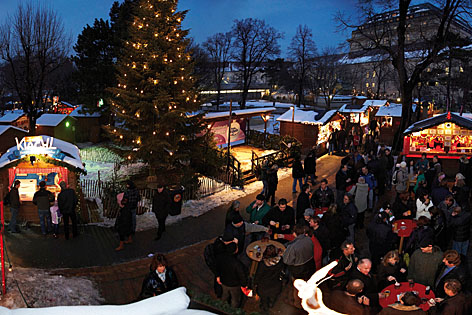
The Viennese Christmas markets have produced even more offshoots on the various squares and plazas of Vienna than I remember from 6 years ago, and the smell of various spiced, sweet, hot alcoholic beverages is joining the usual olfactory background of wet streets, car exhaust, döner kebab and cigarets. I am currently going through a non-photography phase (yeah, that happens), and even if I wasn't, it would be hard taking pictures at those Christmas markets, especially since I tend to not see them in daylight. I'd get something like two unknown people's faces (probably with one of them in the process of taking a bite of something) three more people's backs, some snow flakes or steam reflecting my flash, and perhaps a chain of lights in the otherwise black background. So, here's something off the interwebs instead:

Adventmarkt Altes AKH
 Image credit: MAGMAG Events & Promotion GmbH, from here.

Glühwein, Feuerzangenbowle, Glühmost etc. can be a very nice thing to have on a cold day. However, I remember Viennese Christmas seasons as month-and-a-half long merciless strings of social Punsch/Glühwein events during which I would get more and more disgusted and fed up with the stuff. There was no way out, unless I stopped attending social events. Even when I pulled the emergency brake and stopped drinking it sometime in mid-December, I could still get very fed up with the smell. My years in Tucson were a welcome break from it. First, you have to wait for the weather to get cold enough to warrant making hot drinks (and then there is stiff competition from hot chocolate), second, to the best of my knowledge, there were two people aside from myself who would make it (a German friend and an Australian friend, go figure…), and third, even if it were a popular drink, it couldn't legally be sold and consumed on every street corner. Two or three Punsch/Glühwein events per Christmas season with American moderation on the amount of alcohol consumed turned out just right for me. Of course, this year, my Punsch/Glühwein consumption has ramped up a little, but so far, things are under control. I presume some combination of no longer being a student and still being "new in town" is my saving grace.

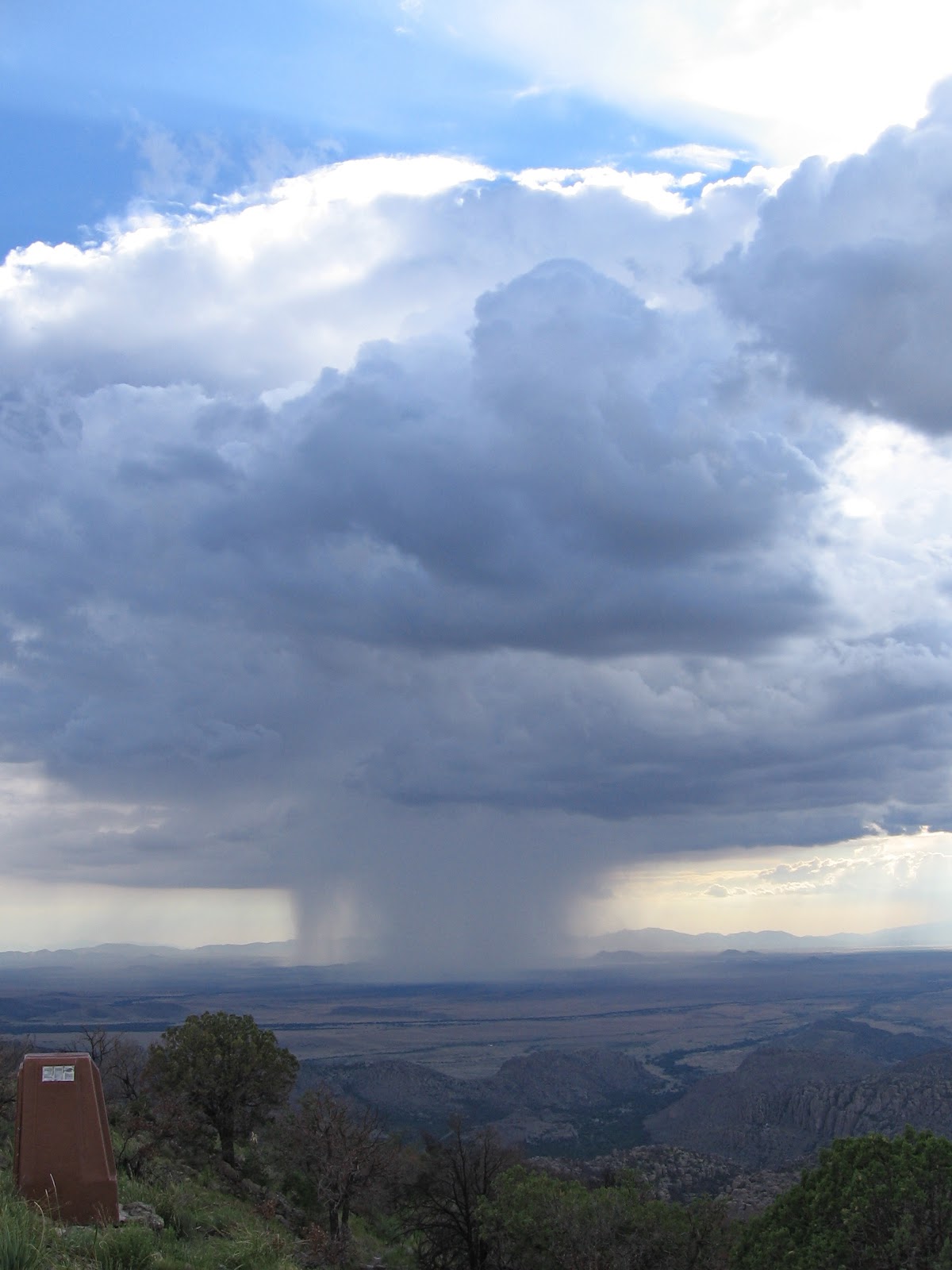
But back to the seasons - what is mind-blowing to me is how fast they have changed. In absolutely no time, beautiful fall has turned into real winter - just yesterday, it seems, that tree in front of my office still had leaves on it! Sounds like a trite platitude about how time moves on oh so quickly, and I wouldn't be writing about it in my blog, if I didn't remember the exact opposite feeling from my first months in Tucson. I arrived on July 27, 2007, it was sunny and hot, and it was monsoon season - I distinctly remember the creosote smell in the air, and how I was wondering what on earth that was. Even though, of course, people immediately taught me about it, monsoon didn't mean anything to me. You have to live through the rainless Tucson spring and early summer to understand. The thunderstorms were neat and sometimes spectacular, but the Alps have pretty impressive convective summer thunderstorms, too, and rain as such wasn't anything special to me yet. The change of season from monsoon to fall didn't register a whole lot with me either, partly because I had not yet developed much sensitivity to the high temperature ranges. To me, there was no real difference between the low 90's or the mid-100's, and besides, I did not have my mind wrapped around the Fahrenheit scale yet, so the numbers made no intuitive sense anyway. As far as I was concerned, it was sunny and hot every day, and that meant it was "summer". So, from July to November 2007, it felt like time was not moving at all.

Only over the course of a couple years did I calibrate to the comparatively subtle seasonal changes in Tucson: The winter low desert hiking season and the gorgeous sight of the occasional snow in the Catalinas. The running streams and fields of golden poppy in spring. The dreadful June cooped up in air-conditioned buildings watching the news on wildfires, with the occasional escape to Mt. Lemmon or Mt. Graham. And, of course, monsoon: the slow buildup of clouds, the first time it's humid enough to smell the creosote, and eventually the first rain, drawing me and my neighbors, who I would never see otherwise, out of our suburban dwellings onto the streets, watching the miracle of water falling from the sky. Then the flooding streets, the lower temperatures, plants that had looked half-dead growing leaves, the slopes of the mountains turning green. And the gorgeous sunsets produced by the clouds.


When describing the excitement of Tucsonans about monsoon to Austrians, I used to say that it was like getting excited about the first snow. It probably helped conveying it, but I am not so sure it's doing it justice. Yes, people were commenting on the first snowfall this year, and the second. (The first was a freak one in October, a week after my arrival.) But the talk about beautifully "sugar-dusted" houses and hills, Christmas mood and soon-to-open ski lifts is not comparable to the level of excitement and dominance in conversations that accompanies the first monsoon storms. And one thing is completely missing from the "first snow" talk: the enormous sense of relief. Snow is a welcome and exciting thing (with some downsides, mostly related to traffic, but that's the same with the monsoon), but in the end, people feel more or less entitled to it. Monsoon rainfall is viewed as a gracious gift.